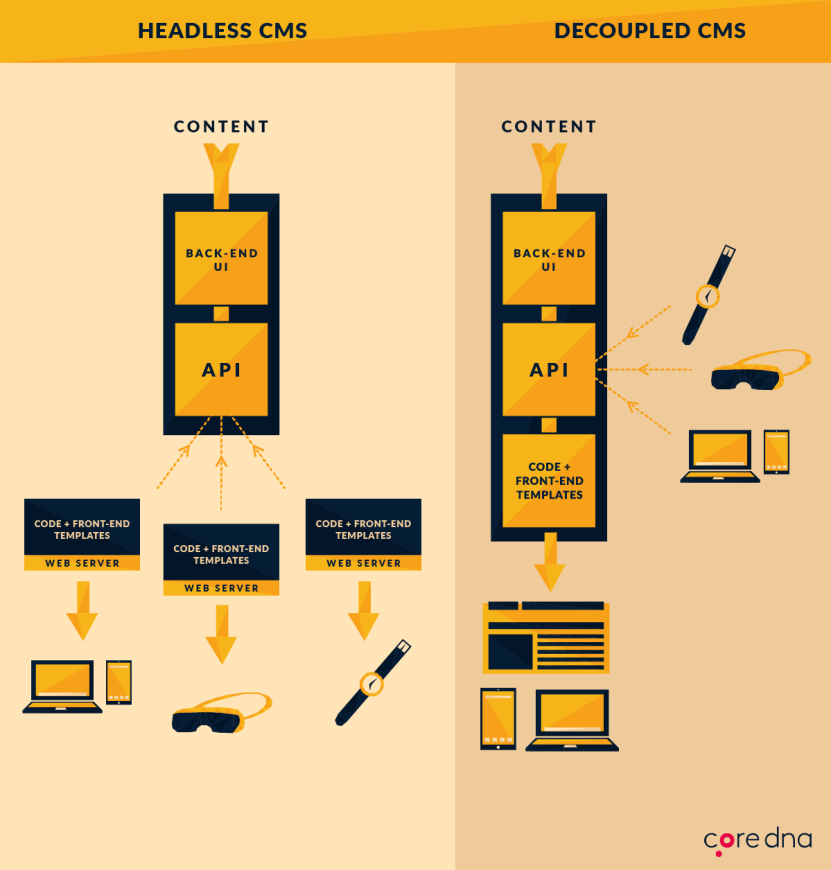
What are the differences between decoupled CMS vs headless CMS architecture?
A decoupled CMS may have a front-end framework built into the system.
For example, Core dna supports templating through Smarty and Twig. A templating engine for PHP, Smarty facilitates the separation of presentation from application logic code. Meanwhile, Twig provides a modern templating engine that is easier to learn, faster, and more secure than PHP.
On the other hand, in a Headless CMS system, the interface is generally connected through an API. Also, there may be no provisions for a front-end framework to support accessing the API in some cases.
In essence, everything must be constructed from scratch. Still, many headless platforms provide SDKs that provide access to the API using some of the more commonly available and popular frameworks like React mentioned above, Vue, and others.
The Core dna approach to headless is to give the developers the flexibility to deliver solutions in a pure headless using their own front end approach and to also give those developers looking for a quick solution a way to use the templating to deliver their outcomes.