Course Content
M2: Headless Commerce
The world of eCommerce is changing. You might even say that it has lost its head. With consumers getting used to consuming content and making purchases through various touch points — from IoT devices to progressive web apps — legacy eCommerce platforms are struggling to keep up with the demands of the customer.
0/9
M4: B2B eCommerce Platform Features
Business-to-business (B2B) eCommerce platforms cater to companies that sell their own products or services to other businesses. B2B eCommerce platforms are popular with companies looking to diversify their revenue streams.
0/21
M5: Adobe Magento Commerce
Adobe commerce (formerly Magento Commerce) has proven to be a popular choice for enterprise eCommerce brands. According to Salmon, Magento accounts for 31.4% of top 100,000 eCommerce sites.
0/5
M6: Adobe Magento 2 Migration
Adobe Magento powers around 9 percent of the world’s eCommerce sites — and a great number of those users are at a crossroads: Should we go through the process of migrating to Magento 2, or should we explore pastures anew?
0/8
M7: Speed Up Your Website and Applications
Site speed is critical for a successful website. Speed affects everything from a website's visibility on SERPs to conversion rates, engagement, and overall customer satisfaction. Needless to say, optimizing your website's speed is a necessity, but that doesn't make figuring out how to do it any easier.
0/14
M8: Panama Papers: 2 Key Breaching Open Source Platforms
The hacking of Mossack Fonseca’s client portal leaked over 11.5 million documents, 4.8 million emails and 2.6TB of data - the largest leak in history. Prime ministers have resigned, business people are being scrutinized and over 30 countries have launched investigations against individuals and companies.
0/4
M9: Contentstack
Deciding on your next content management system can depend on several factors, including your current tech stack, the requirements of different departments, your current priorities and where you see your business heading in the future.
0/10
Case Study 1: Did You Start Up a New Media Behemoth in 2005? These Guys Did…
Does the year 2005 feel like yesterday to you? Can you believe we’re now laying on the nostalgia about the events of just over 10 years ago?!
0/6
Case Study 2: What Does Adobe Acquiring Magento Mean For..?
“Adobe to Acquire Magento Commerce” was the straightforward headline of the press release that popped up in my news alert. Just five simple words. And yet, their impact could be tremendous. An impact that will be felt differently, depending on your role and relationship with these two software companies.
0/7
Case Study 3: Music Streaming No Longer Just For Men on Pirate Ships
You know it’s an election year when every face on your TV is suddenly an expert in human psychology.
0/1
Case Study 4: Core dna vs BigCommerce vs Shopify Plus: Platform Standoff
This lesson will analyze BigCommerce, Shopify Plus, and Core dna to see which platform best suits forward-thinking online retailers looking to provide experiences, not just products.
0/1
Case Study 5: Acquia Acquired For $1B: What Does It Mean For Their Future?
The acquisition (or should we say, Acquiasition) may not come as a surprise to those who have followed Acquia’s story closely over the past few years. In a 2018 article for Xconomy, CEO of Acquia, Michael Sullivan, hinted that the company might end up selling “to accelerate (growth) even faster.”
0/1
Case Study 6: The Amazon Survival Guide: Thriving in The Age of Amazon
Amazon’s dominance over the eCommerce market is almost scary. 44% of all product searches, in fact, start with Amazon. They own 43% of all U.S. online retail sales. That’s almost half the market!
0/5
Case Study 7: Ascedia – Providing A Headless Solution For Standard Process (Case Study)
How Ascedia helped nutritional supplement giant, Standard Process, rewrite the way they engaged with their customers.
0/4
Assessment + Professional Diploma Certificate
eCommerce Platform Strategist

What’s the difference between B2C & B2B eCommerce?

The differences in target markets and key decision-makers – an individual or an entire business – leads to different business strategies and technological needs.
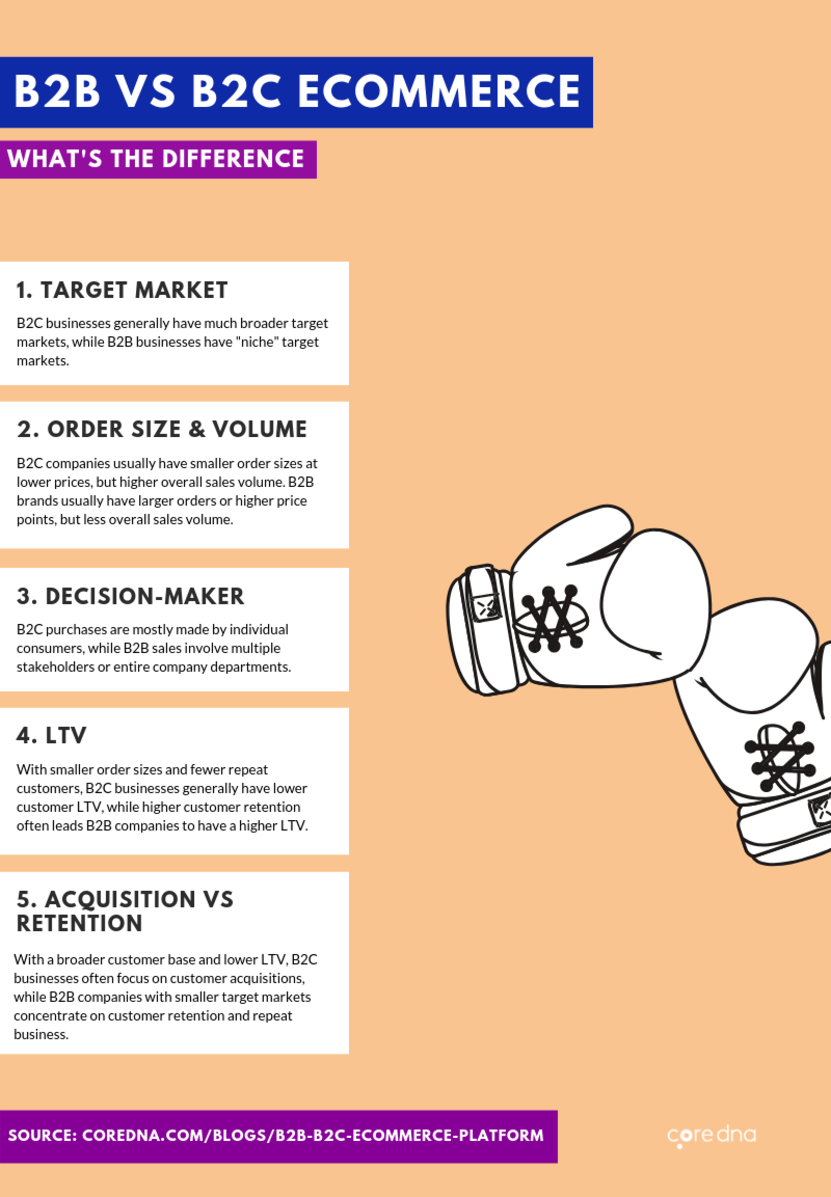
What's the difference between B2B vs B2C eCommerce?

(5 basic differences of B2B vs B2C eCommerce)


1. Target market

B2C businesses generally have much broader target markets, while B2B businesses have “niche” target markets.

2. Order size & volume

B2C companies usually have smaller order sizes at lower prices, but higher overall sales volume. B2B brands usually have larger orders or higher price points, but less overall sales volume.

3. Decision-maker

B2C purchases are mostly made by individual consumers, while B2B sales involve multiple stakeholders or entire company departments.

4. Customer Lifetime Value (LTV)

With smaller order sizes and fewer repeat customers, B2C businesses generally have lower customer LTV, while higher customer retention often leads B2B companies to have a higher LTV.

5. Customer acquisition vs. retention

With a broader customer base and lower LTV, B2C businesses often focus on customer acquisitions, while B2B companies with smaller target markets concentrate on customer retention and repeat business.